
What four weeks of Writing Our World™ did for 11 students
We run a four week summer writing intensive at our learning centers every year, and every year I end up with a folder of before and after writing samples that basically nobody sees except the families. This summer I decided to actually share them, because I think teachers need to see what's possible in a month when writing is taught in the right order.
So here's what you're looking at. Two Redwood Literacy centers, one in Nashville and one in Evanston, just north of Chicago. Kids going into 2nd through 8th grade. Most of them have dyslexia, dysgraphia, or ADHD, and most of them came in hating writing. They wrote for 75 minutes every day for four weeks, using Writing Our World™. Assistive technology like speech to text was available the whole time for any kid who needed it.
I took the names off. Everything else is exactly how the kids wrote it. The spelling, the missing capitals, all of it. I didn't want to clean these up because the messy version is the honest version and it's the one you'll recognize from your own classroom.
Nashville
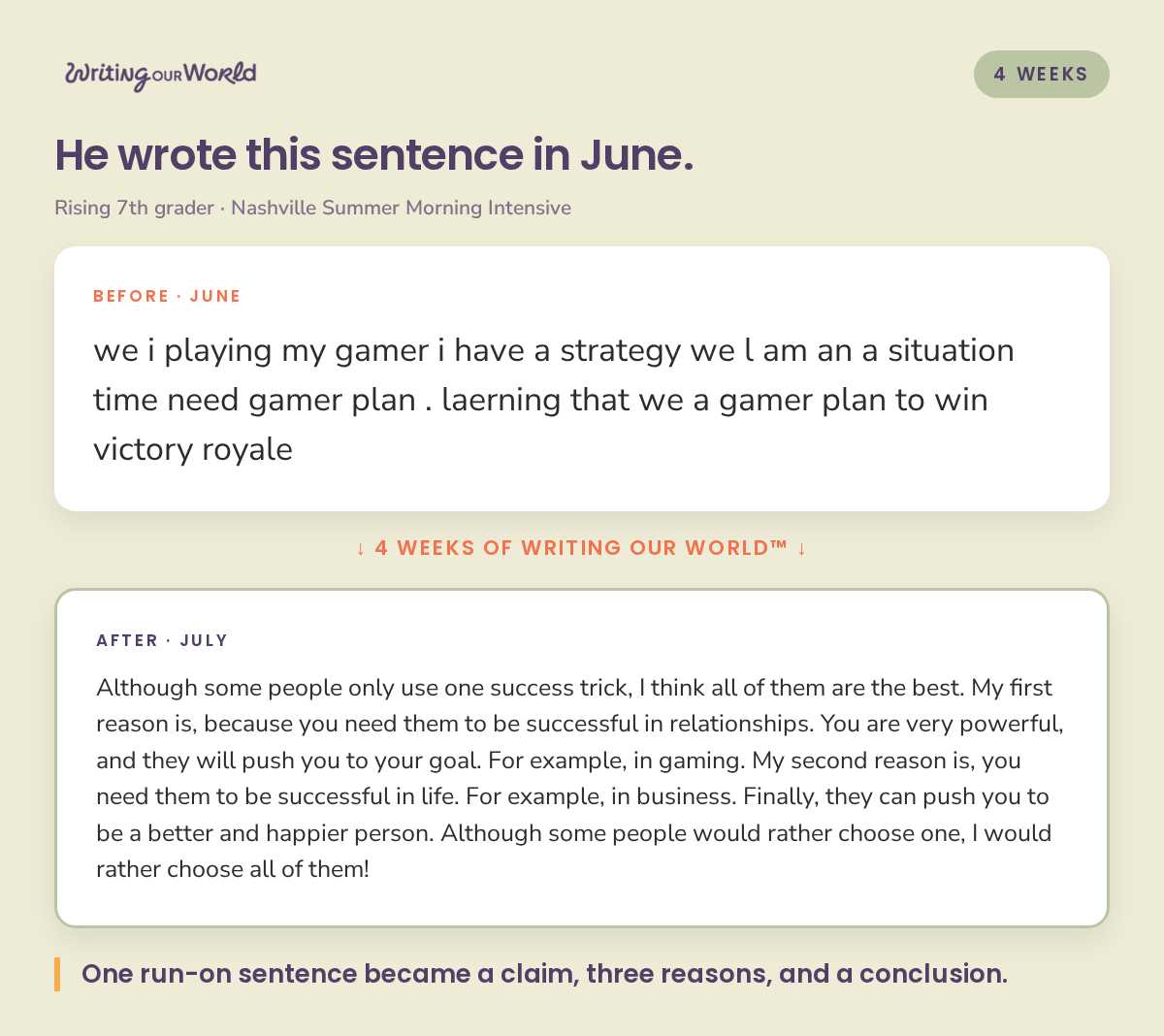
Going into 7th grade. His June sample is one long run-on about a video game. By July he's stating an opinion, backing it up with three reasons, and wrapping it up at the end. Same kid, same interests, he just finally had a structure to put his thinking into.
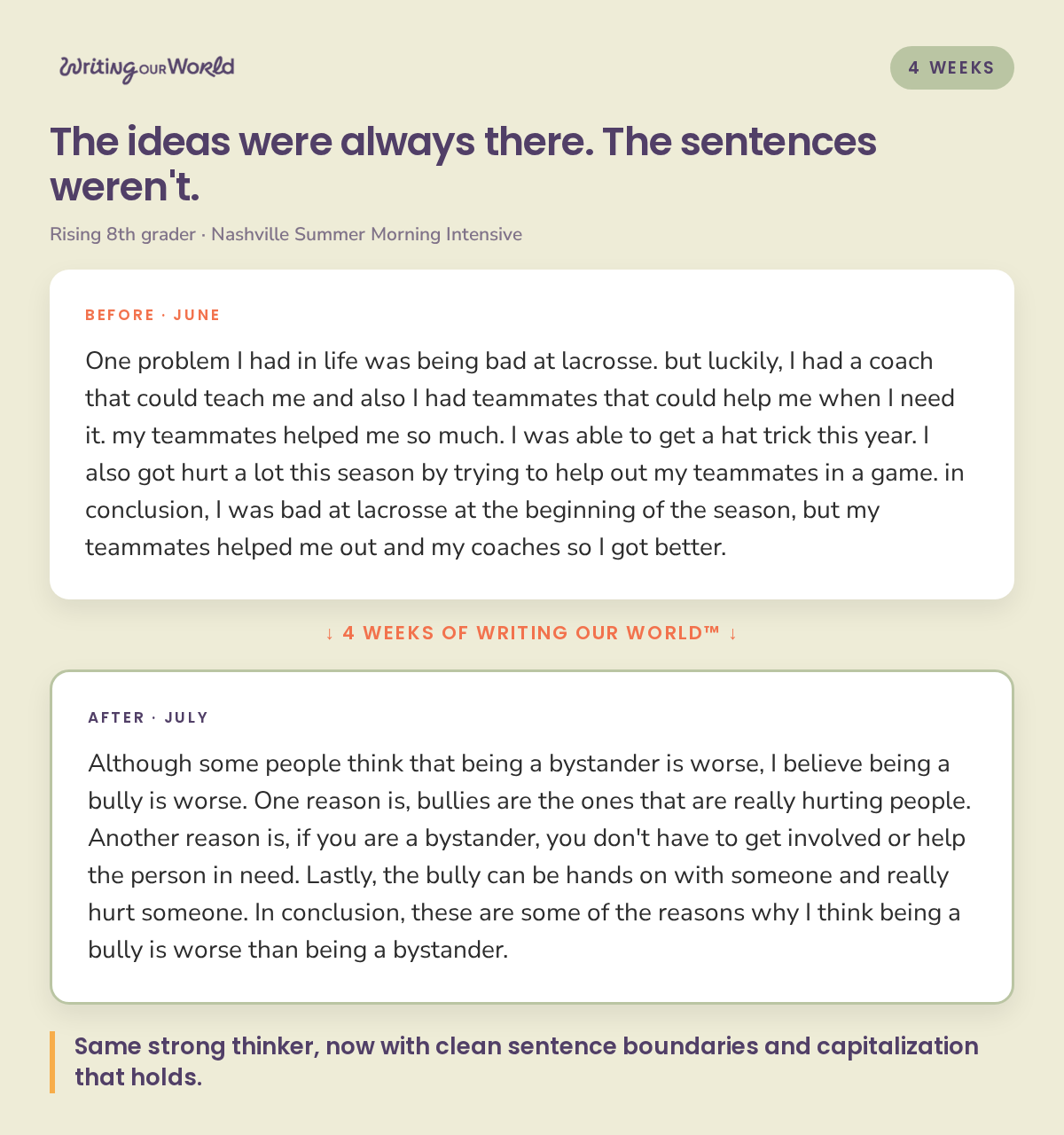
Going into 8th grade. If you read the first sample slowly you can tell he has plenty to say. The problem is all mechanics. Sentences run into each other and the capital letter disappears after every period. Four weeks later the ideas are the same and the writing finally looks like what's in his head. This is the kid every teacher has, the one where you say "he's so smart, he just can't get it on paper."
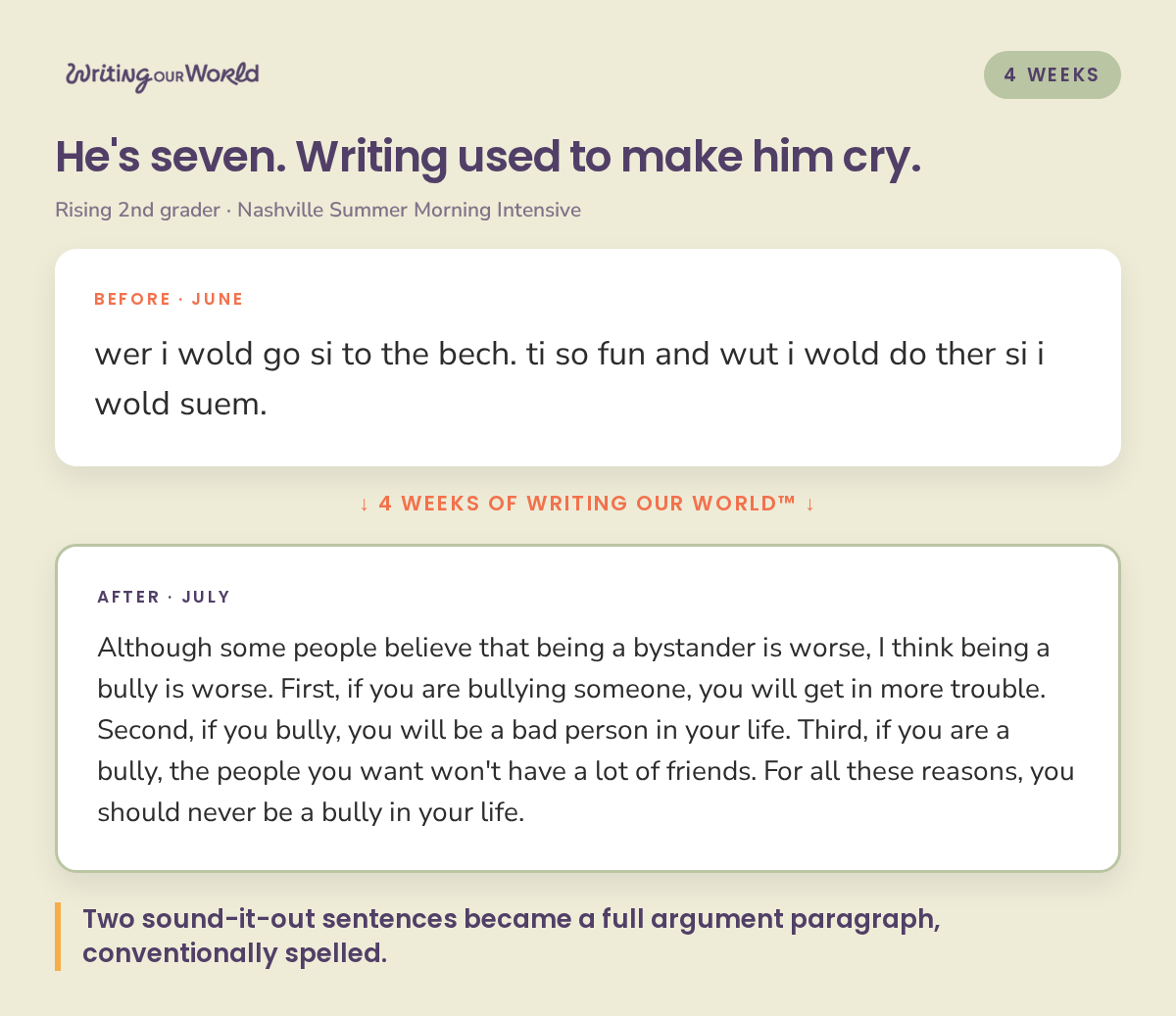
Going into 2nd grade. Two sounded-out sentences in June. A full opinion paragraph in July. He's seven. The thing the graphic can't show you is that he started the summer frustrated and ended it asking if he could have more writing time.
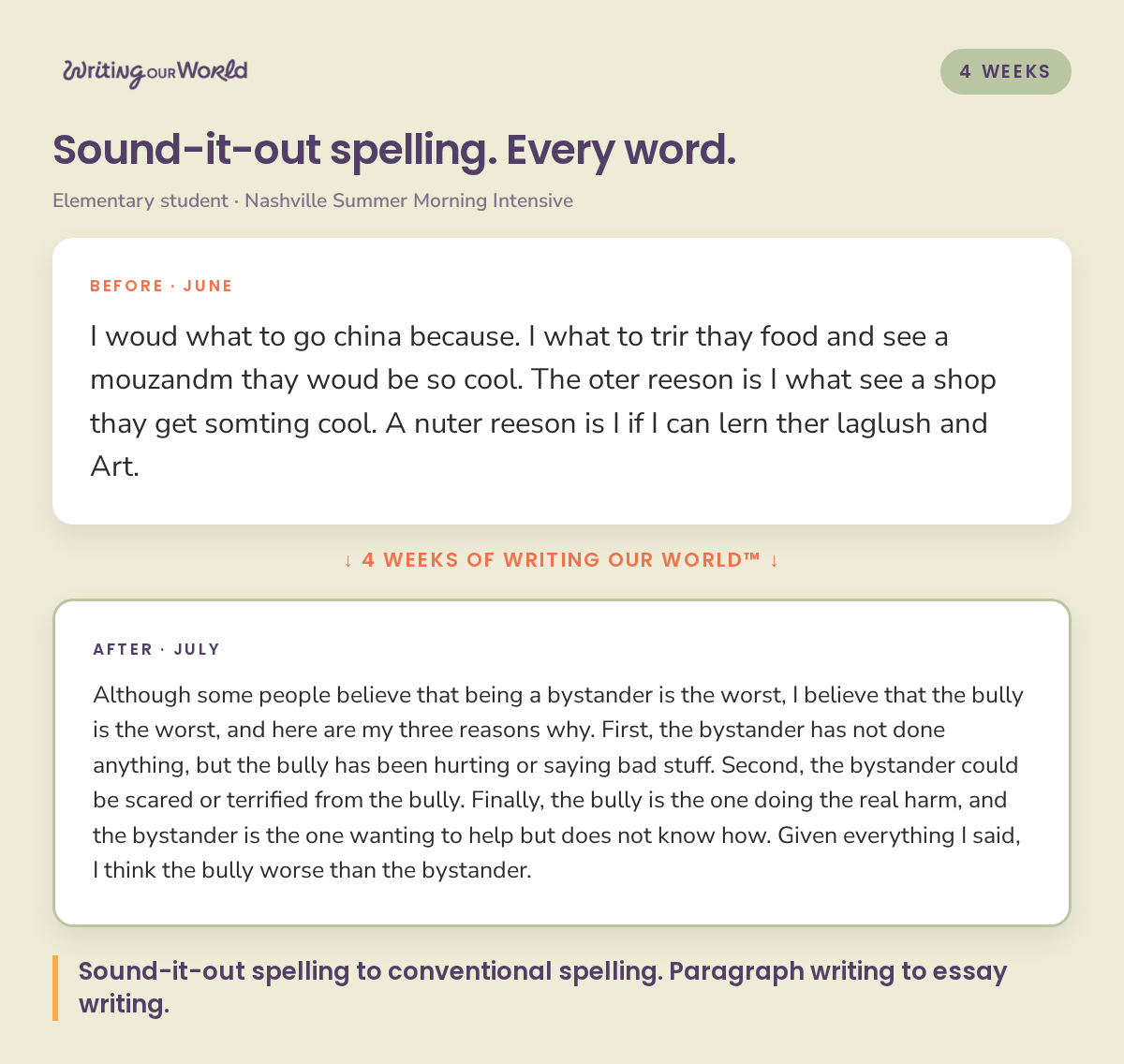
Elementary student. Look at the spelling in the first sample and then look at the second one. That's one month. We were doing decoding work and writing work with him at the same time, which is really the whole reason I built this curriculum the way I did, because kids with dyslexia need both and they usually only get one. He moved from paragraph level to essay level on our placement over the summer.
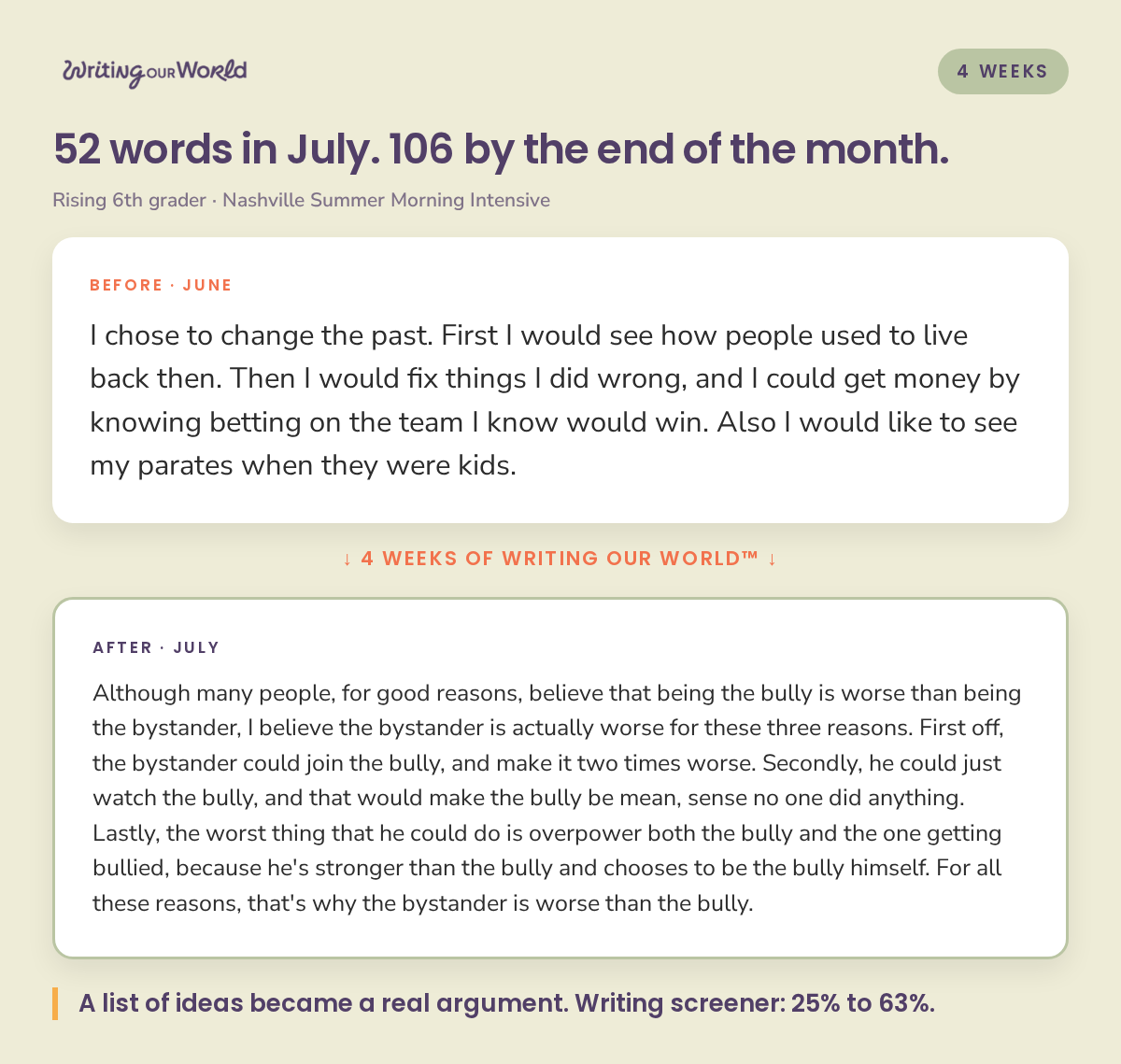
Going into 6th grade. He went from 52 words to 106, but honestly the length isn't what I care about. The first sample is a list of things he likes. The second one takes a side, gives three reasons, and comes back to the point at the end. That's a different kind of writing.
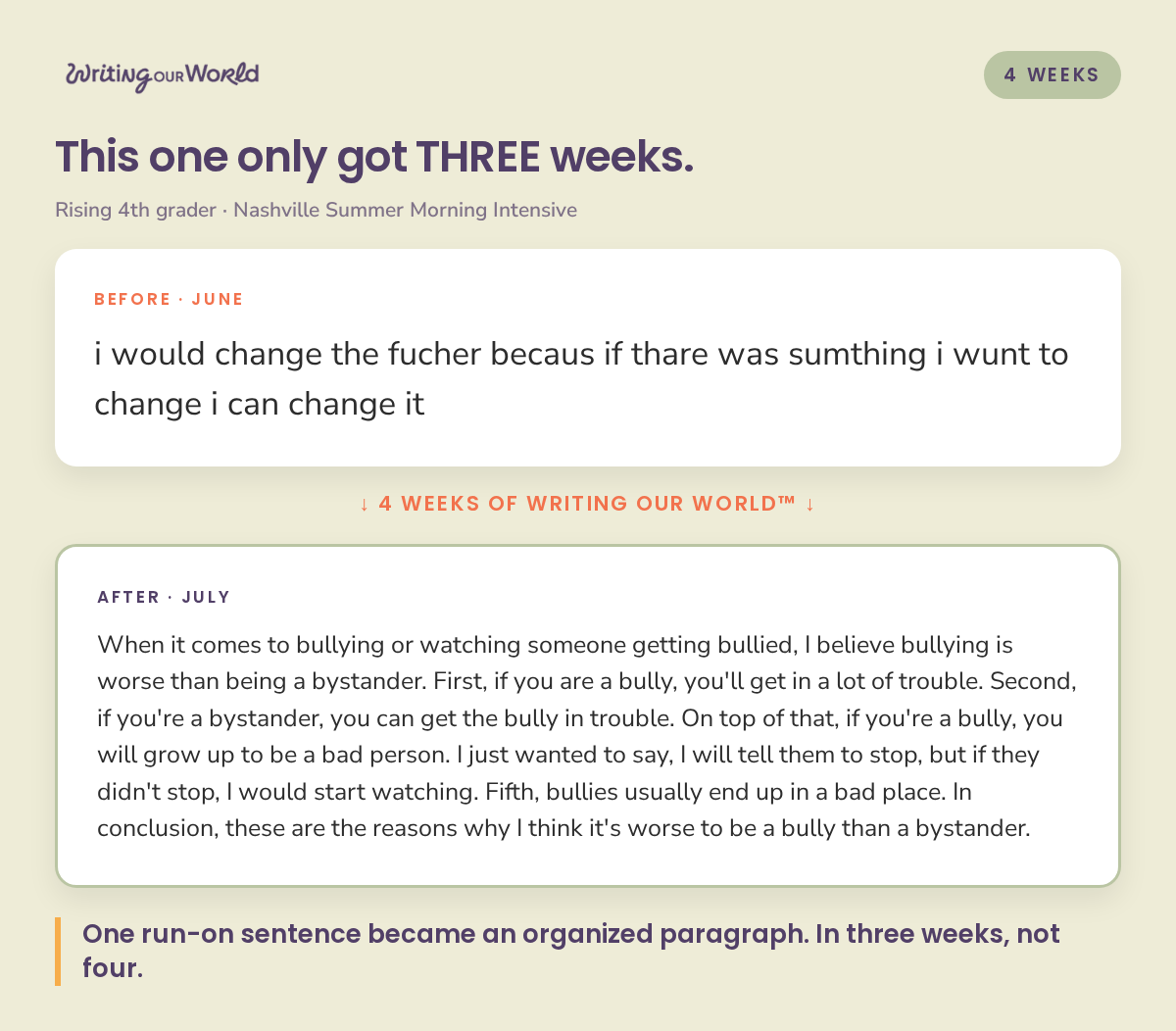
Going into 4th grade. He only got three of the four weeks because he left for another camp. His first sample is one lowercase run-on. His last one is an actual paragraph with a topic sentence, reasons, and an ending. His reading came up to grade level over the same stretch too.
Evanston
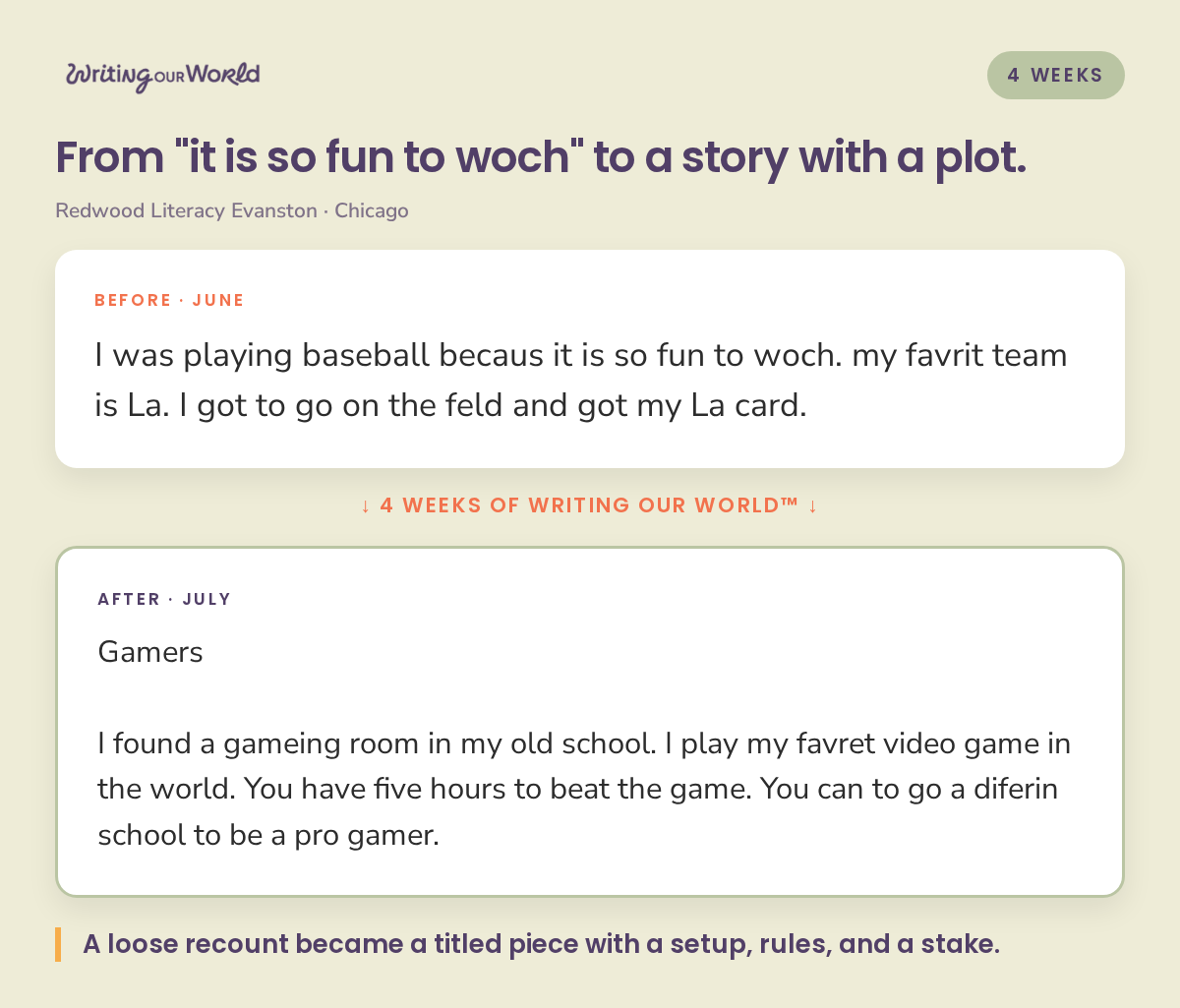
From a few facts to a real piece. In June this was a few facts about a baseball game, one after another. In July it has a title, a setting, rules, and a goal. It reads like a story instead of a list.
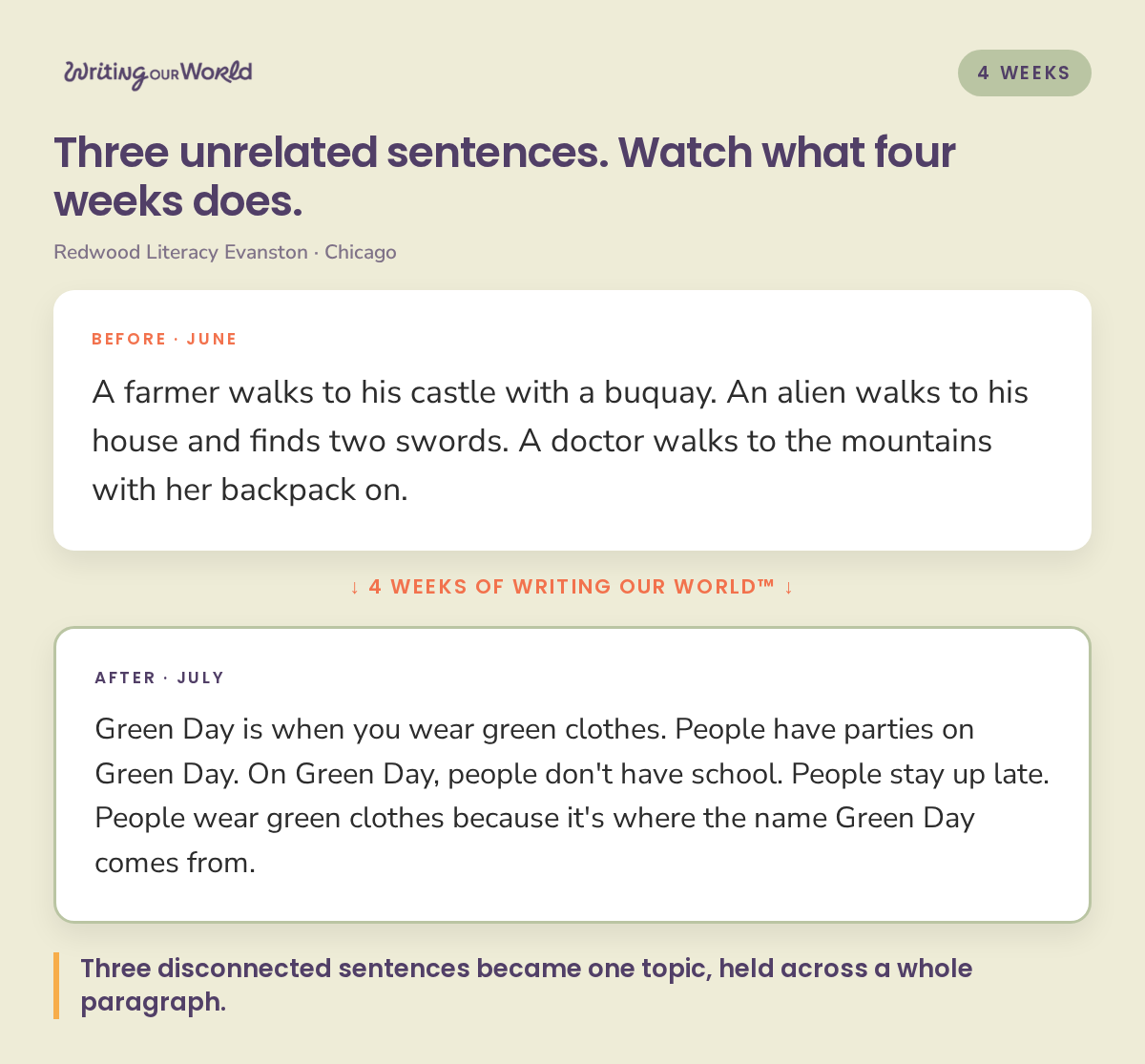
Three sentences about three different things. That's the first sample. Nothing connects to anything. In the second one, this student stays on one topic for a whole paragraph and even goes back to explain where the name came from. Staying on topic is not something kids just pick up. You have to teach it, and it's teachable.
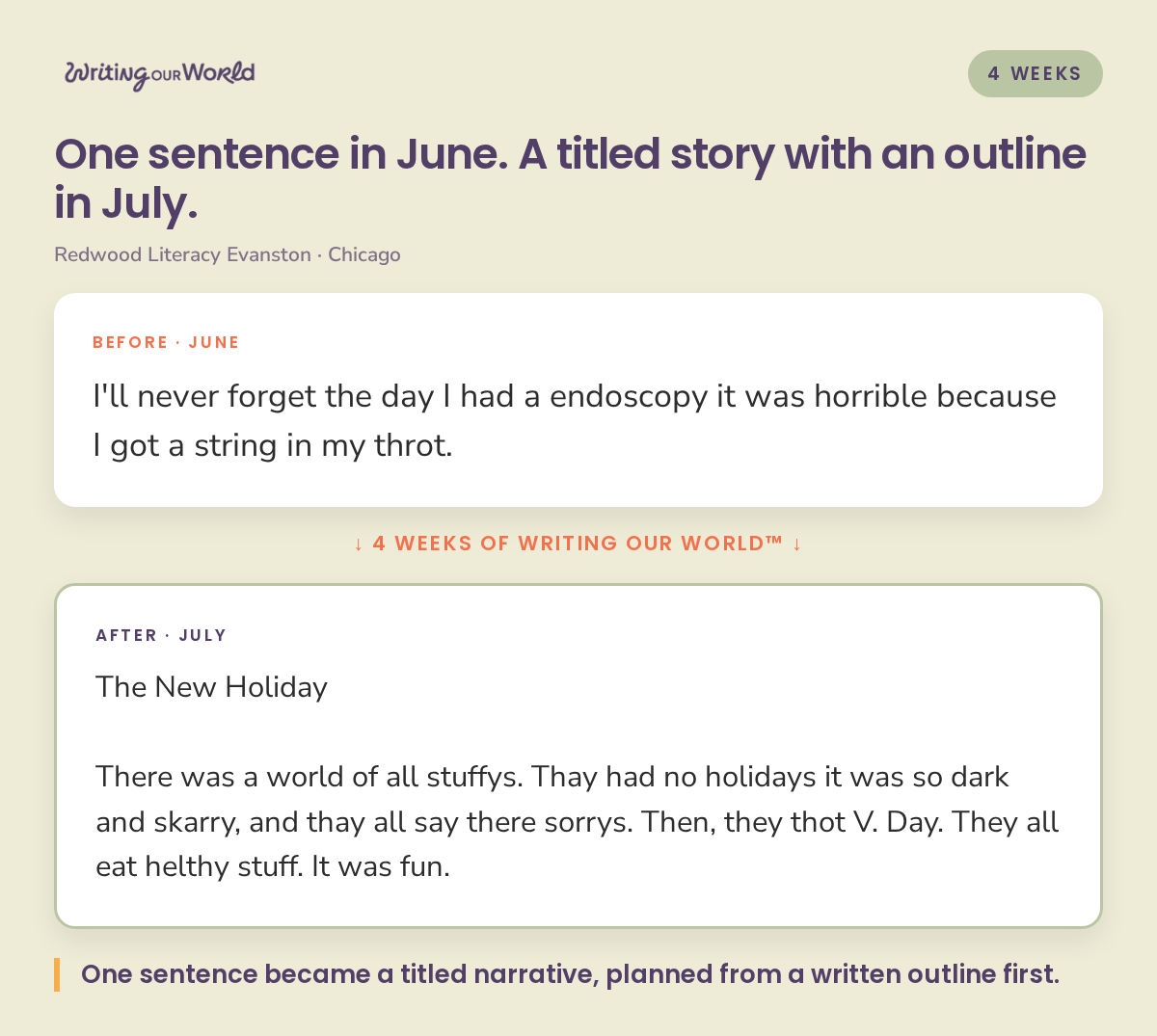
One sentence in June, a titled story in July. By the end of the summer this student was outlining before writing. A few bullet points first, then the paragraph. Once a kid has that habit, writing stops feeling like an impossible blank page.
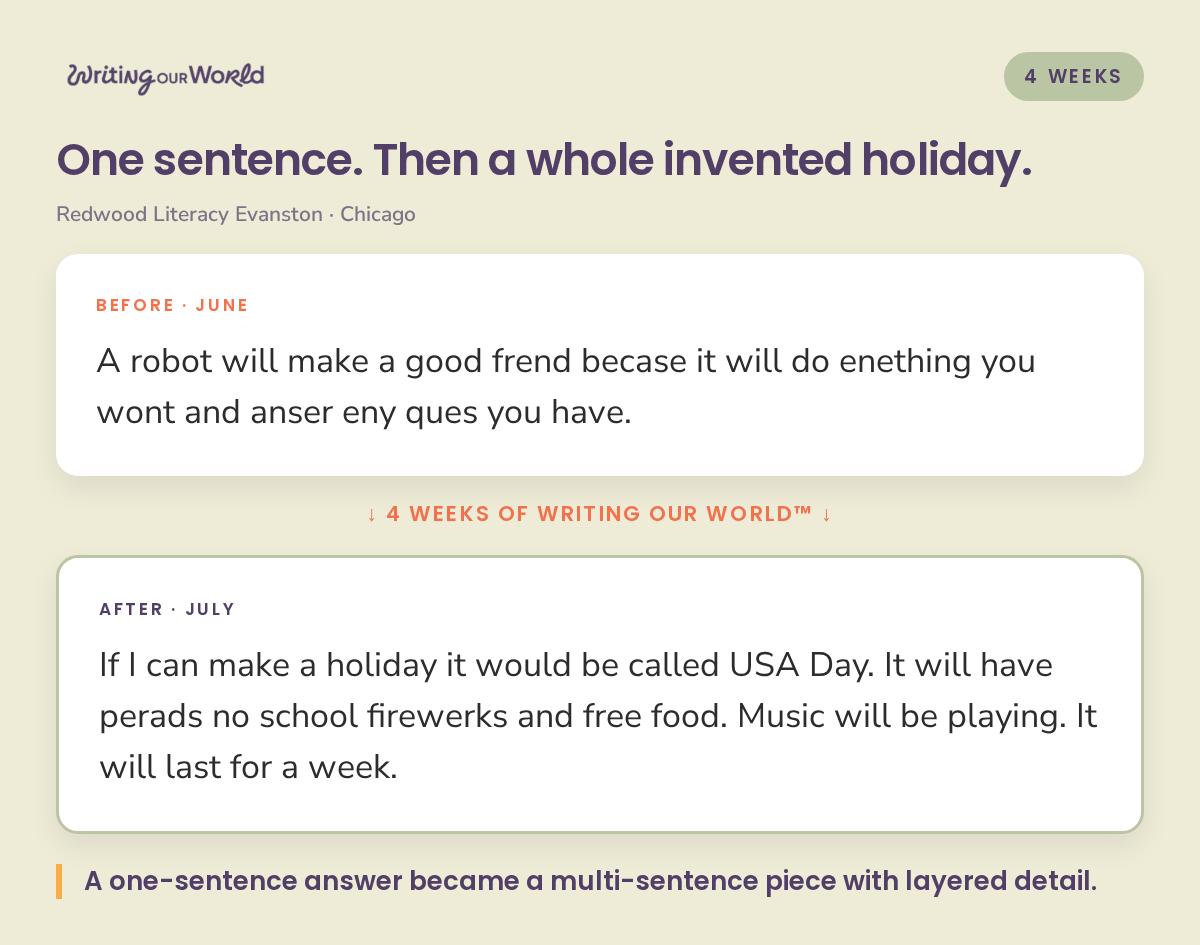
One sentence, and that was really all he could get out. Four weeks later he made up his own holiday, with parades, food, music, and how long it lasts. He had those ideas the whole time. He just didn't have a way to get them onto paper.
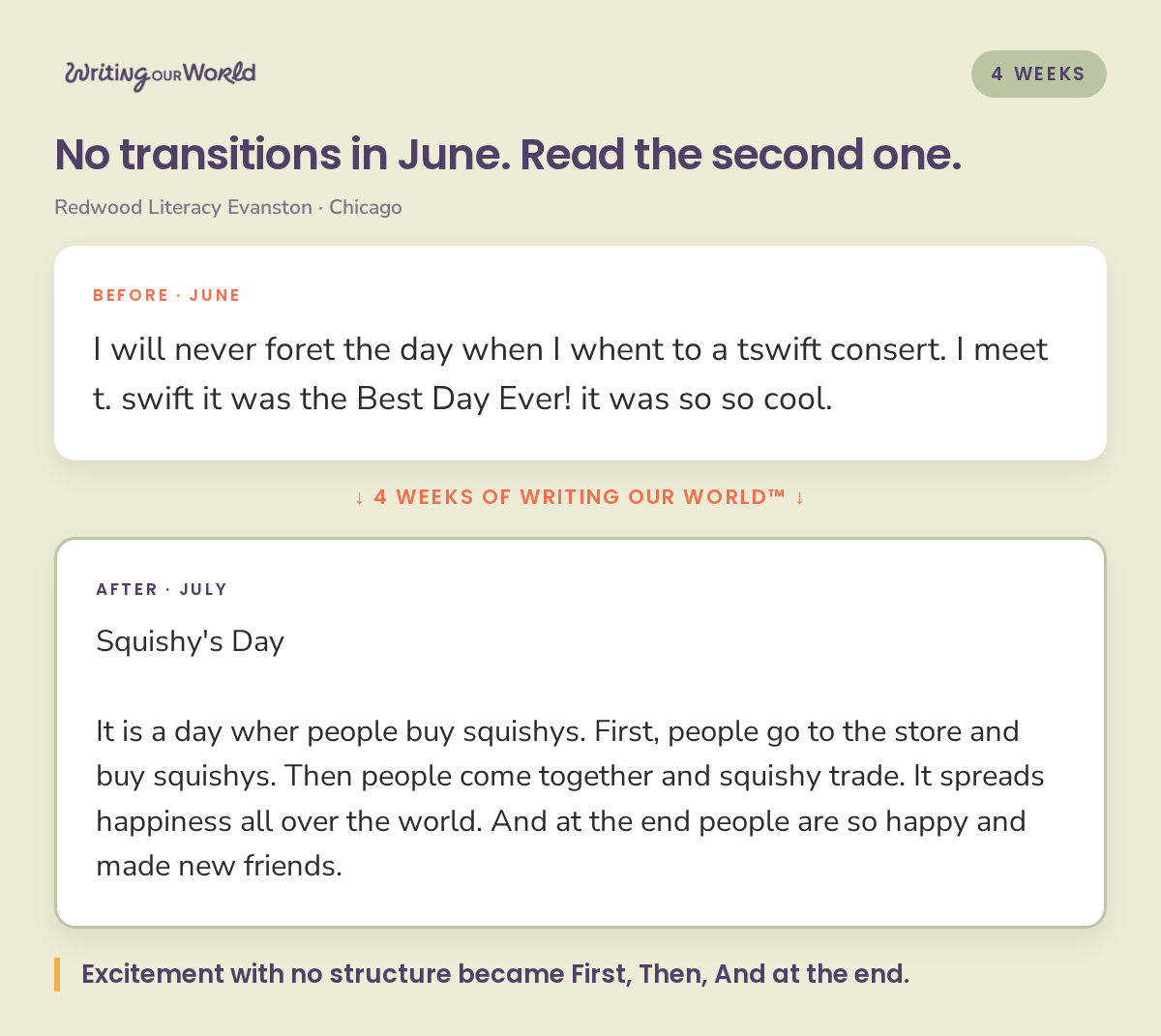
First. Then. At the end. Those little words are the difference between a kid dumping excitement onto the page and a kid telling you what happened in order. We teach them directly, and it takes way less time than people think.
What I'd want you to notice
None of these kids became different kids over the summer. What changed was the instruction. We worked at the sentence level first, every day, before asking anybody for a paragraph. They had sentence starters, a simple planning routine, and permission to use speech to text if handwriting was the thing getting in the way. They wrote about stuff they actually cared about. And they wrote every single day, which matters more than anything else on this list, because most students with learning differences write almost nothing during a regular school day. It hurts, so they avoid it, so they never get the reps.
That's it. That's the method. I know it sounds too simple. It works because it's done in order and done daily.
If you want to try this with your students
Step 1 of Writing Our World™ is free. It's the sentence level work every one of these kids started with. Fifteen lessons, the slide decks, and the student handouts.
If you want all of it, that's the Writing Our World™ 3.0 Membership. Steps 1 through 8, every deck and handout, the Expository Writing Skill Screener so you can place kids and track them, and the assistive technology routines. It's normally $349 a year.
Right now I'm opening 1,000 Founding Teacher seats at $250 a year, and that price stays at $250 for as long as you keep your membership. The founding price goes away January 1, 2027, or when the 1,000 seats fill up, whichever happens first.
Claim a Founding Teacher seat →
I'll post next summer's set too. If you try Step 1 with your class, I'd genuinely love to see what your kids write.
Kait Feriante
Teacher, dyslexia specialist, and co-founder of Redwood Literacy and Writing Our World™


