
The research behind Writing Our World™
We read the research on how struggling writers learn. We could not find a tool that put it into a classroom in 15 minutes a day. So we built one, and we have taught it to our own students since 2019.
Built over five years by a team of dyslexia and learning-behavior specialists at Redwood Literacy. Grounded in multiple research frameworks. Reviewed by literacy expert Joan Sedita.
Start for Free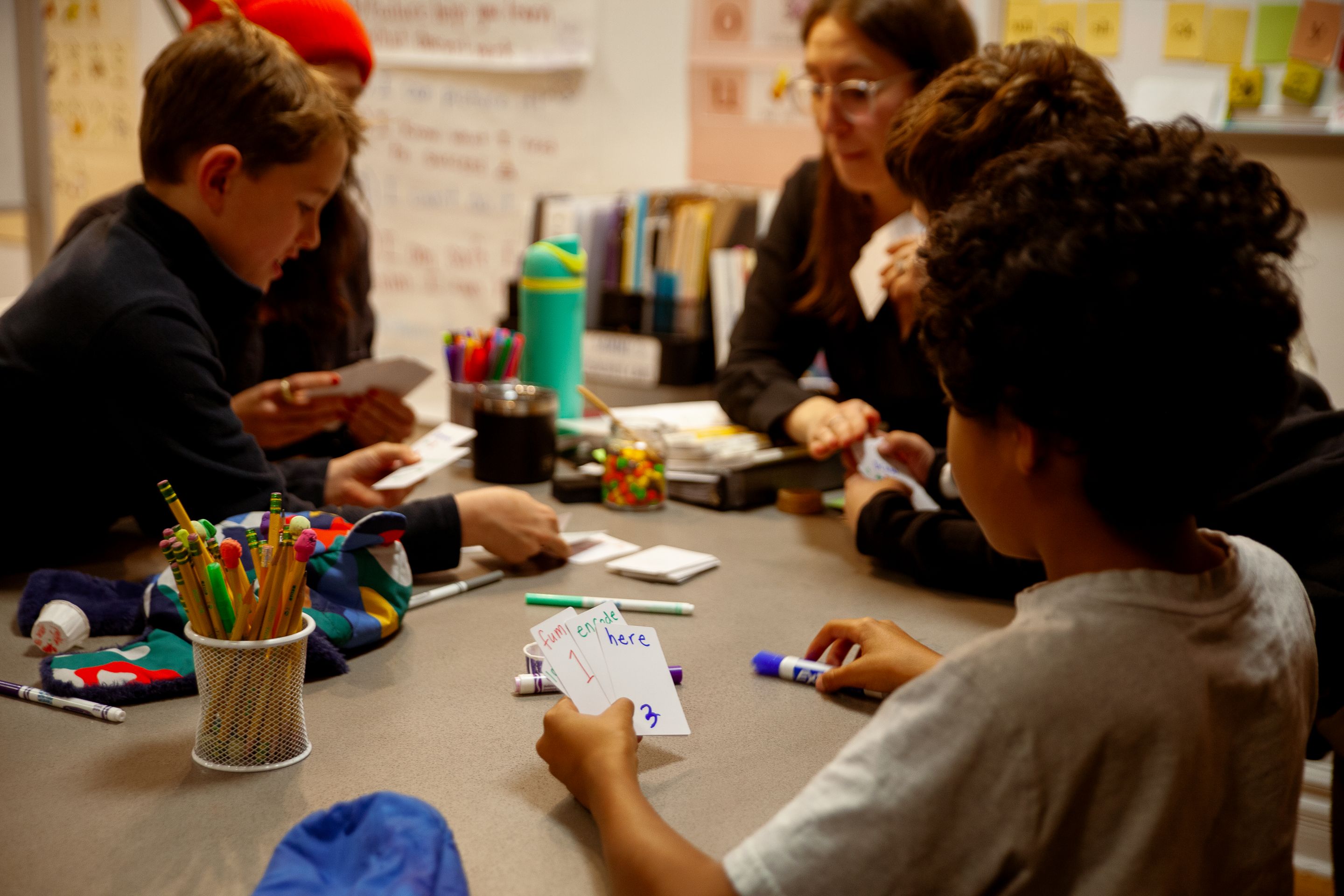
Born in a classroom, not a boardroom
Writing Our World™ started in 2019 at Redwood Day School, our full-day program in Chicago for students with dyslexia. Our team of dyslexia, dysgraphia, and learning-behavior specialists had read the research on explicit writing instruction: The Writing Revolution®, The Writing Rope™, the structured literacy principles we already used to teach reading. We believed it. We just did not have the tool that put it in front of a struggling writer, in order, every day.
So we wrote the lessons ourselves, taught them the next morning, and kept what worked. Five years later that folder of lessons is a complete intervention curriculum: eight steps, more than 100 scripted lessons, student materials, assessments, and assistive technology routines. We still teach it every day at Redwood Literacy centers in Chicago, Evanston, and Nashville, and every edit still comes from a classroom.
To be clear: Writing Our World™ has no affiliation with, and has not been endorsed by, The Writing Revolution, Inc., Keys to Literacy, or any other organization named on this page. We name them to credit the roots of this work, nothing more.
Reviewed by Joan Sedita
Founder of Keys to Literacy, creator of The Writing Rope™ framework, and author of The Writing Rope: A Framework for Explicit Writing Instruction in All Subjects. In 2025 she reviewed the full curriculum. Her words, unedited:
“The practical, well-organized lessons that make up Writing Our World™ are based on an explicit, structured approach to teaching writing that is beneficial to all students, especially those who struggle with writing. Lessons that are aligned across grades K-12 are a real plus in terms of consistent terminology and instructional practices as students move from grade to grade.
In addition to alignment to the scope and sequence of skills identified in The Writing Revolution®, the WOW™ lessons are aligned with several instructional components identified in The Writing Rope™ instructional framework, including the syntax, text structure (including paragraph structure), and critical thinking strands of the rope.
The K-2 lessons are developmentally appropriate, taking into account the unique needs of young beginning writers. The continued emphasis on the development of sentence and paragraph writing skills as students move into upper grades makes WOW™ a great choice for supplemental and intervention writing instruction for older struggling writers.
Congratulations to the authors of WOW™ for developing a set of instructional lessons that will help teachers and schools address the need for quality writing instruction.”
— Joan Sedita, Keys to Literacy
What the research says, and where it lives in the lessons
Six findings we built around. The left side is the research. The right side is what a teacher actually opens on Monday.
Explicit, sentence-level writing instruction
Hochman & Wexler, The Writing Revolution; Graham, Harris & Chambers, 2016 (review of reviews on evidence-based writing practice).
Every student starts at the sentence. Step 1 alone is 16 substeps: fragments, run-ons, the four sentence types, because/but/so, subordinating conjunctions, appositives, sentence combining. Step 2 expands kernels and reduces sentences to notes.
Syntax, text structure, and critical thinking taught together
Sedita, The Writing Rope (2019).
Paragraph and essay outlines make structure visible (Steps 3, 4, 7). Summarizing (Step 6), fact vs. opinion, ranking evidence, and pro-con essays (Step 8) make thinking visible.
Structured literacy: explicit, systematic, cumulative, diagnostic
Moats, Speech to Print; Berninger & Wolf, Teaching Students with Dyslexia and Dysgraphia.
One scope and sequence, tied to skills rather than grade levels. Every step opens with a pre-assessment and closes with a post-assessment. Free writes are scored with skill-based rubrics so the teacher always knows whether to move on or reteach.
Background knowledge and academic vocabulary drive writing quality
Wexler, The Knowledge Gap; Hirsch, The Knowledge Deficit; Beck, McKeown & Kucan, Bringing Words to Life.
Students never write from nothing. Lessons carry a shared content thread (world geography, languages and cultures) and explicitly teach Tier 2 words from the Academic Word List, revisited across steps.
Executive function and working memory are the bottleneck for struggling writers
Berninger & Wolf, 2009; Scarborough, 2001 (the Reading Rope).
Step 3 opens by teaching students what executive functions are and how they show up in writing. Outlines, sentence stems, and a fixed daily routine take the planning load off working memory.
Universal Design for Learning and assistive technology
CAST UDL Guidelines 2.2; Dell, Newton & Petroff, Assistive Technology in the Classroom.
Every lesson models an assistive-technology tool (speech-to-text, text-to-speech, word prediction) as strategy, not shortcut. Materials are print or digital.
A scope and sequence you can actually read
The way a structured literacy reading program is built: one order of skills, sentence to multi-paragraph essay, for grades 1 through 12. Every step opens with a pre-assessment and closes with a post-assessment.
Getting Started (6 lessons) — Why write? Building a world of knowledge.
Step 1: Sentence Writing (16 substeps) — Fragments, run-ons, four sentence types, conjunctions, appositives, sentence combining.
Step 2: Sentence Expansion & Note-Taking (5 substeps) — Expand kernels with WH questions; reduce sentences to notes.
Step 3: Paragraph Planning & Writing (11 substeps) — Executive function, topic sentences, structured outline, supporting details, conclusions.
Step 4: Outlining Across Genres (7 substeps) — Expository, compare/contrast, narrative, descriptive, argumentative paragraphs.
Step 5: Revising & Editing (8 substeps) — Revision checklists, peer feedback, quotations, proofreading symbols.
Step 6: The Skill of Summarizing (5 substeps) — One-sentence, paragraph, and topic summaries.
Step 7: Essay Planning & Writing (8 substeps) — Thesis statements, introductions, essay outlines, conclusions, multi-genre essays.
Step 8: Writing to Take a Stand (10 substeps) — Fact vs. opinion, ranking evidence, pro-con and five-paragraph argumentative essays with citations.
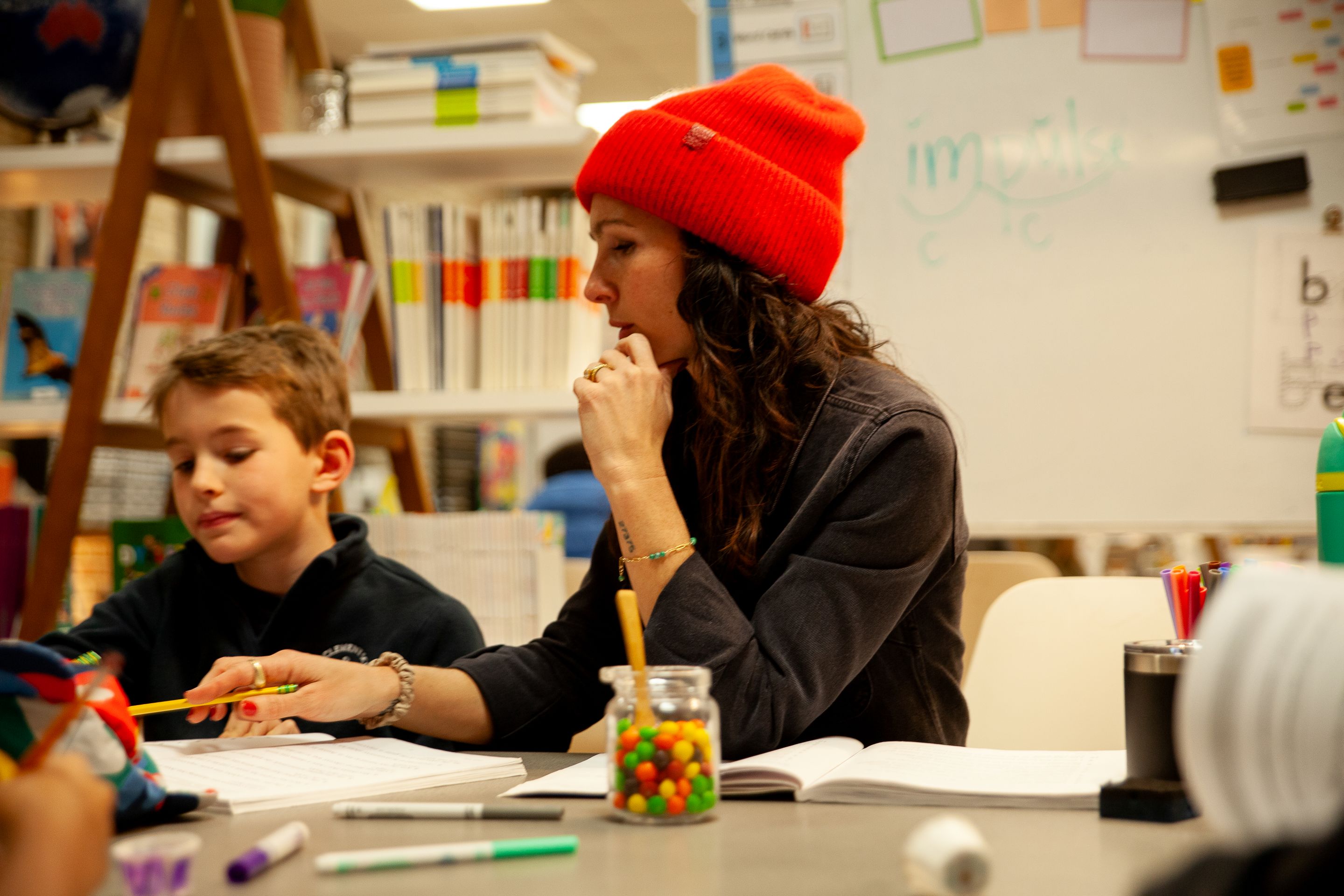
Every lesson runs the same 15-minute routine: state the objective, model the skill (I do), guide practice with sentence stems (We do), students write (You do), share, reflect. Struggling writers stop fighting the format and start using it.
The full scope and sequence, the first six lessons, and Step 1 are in the free Starter Access. See it yourself.
What it does in four weeks
Every summer we run a four-week writing intensive at our learning centers and collect a before and after sample from every student. In 2026 we published eleven of them, from two centers (Nashville and Evanston), students going into 2nd through 8th grade, most with dyslexia, dysgraphia, or ADHD. Names removed. Spelling and punctuation exactly as the students wrote them.
One example. A rising 7th grader in Nashville, before:
we i playing my gamer i have a strategy we l am an a situation time need gamer plan . laerning that we a gamer plan to win victory royale
After 20 Writing Our World™ lessons:
Although some people only use one success trick, I think all of them are the best. … I would rather choose all of them!
Same student, same interests. He finally had a structure to put his thinking into.
Read all eleven before-and-after samples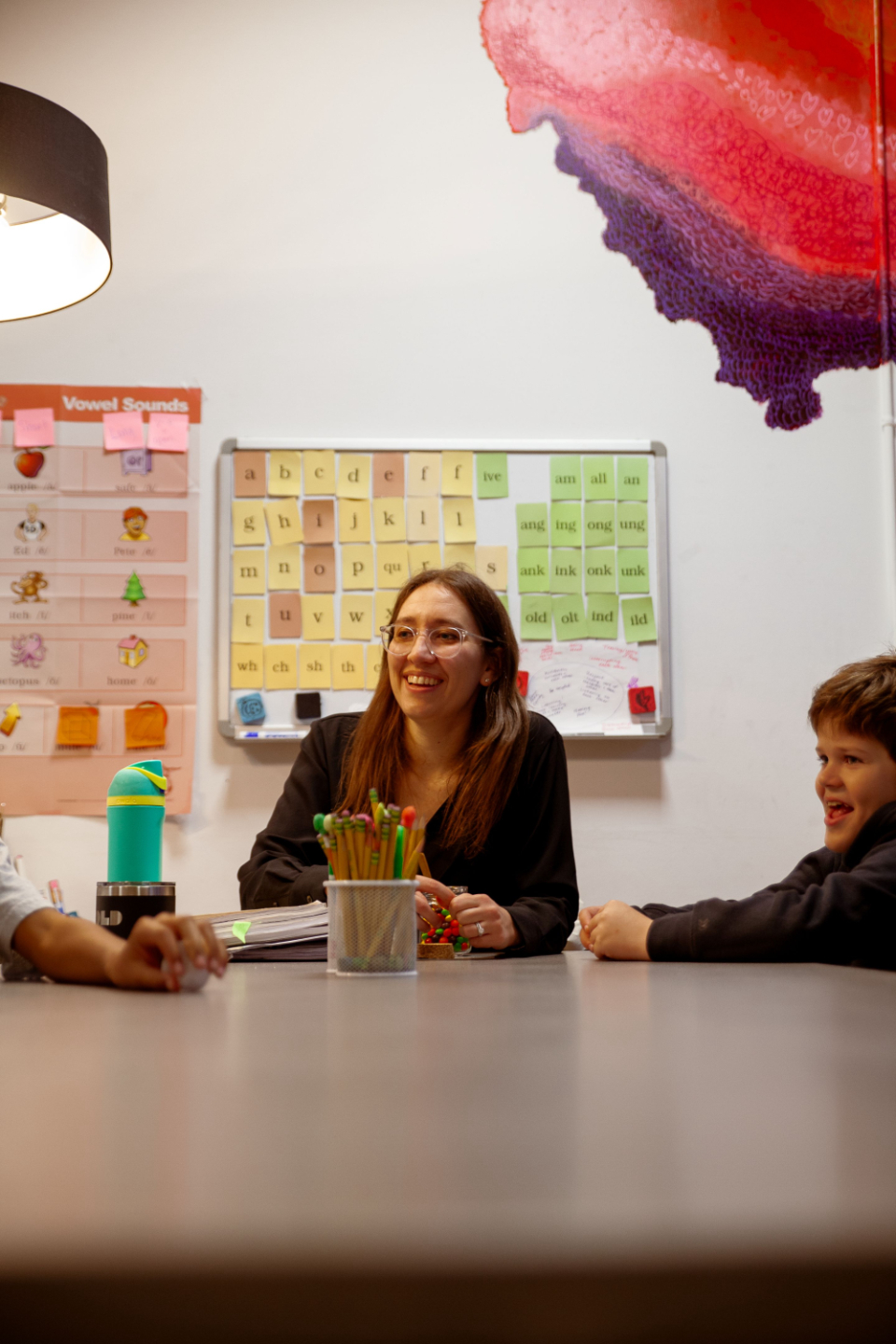
Written by the people who teach it
Writing Our World™ was authored by a team of dyslexia, dysgraphia, and learning-behavior specialists at Redwood Literacy, not a publishing house. Kait Feriante (creator and co-author), Kelsey Coca and Briana Richards (curriculum co-authors), Micah Matthews (editor and co-author), Deana Aurner (assistive technology author), and Kirsten Kohlmeyer (assistive technology consultant). Kait still teaches it four afternoons a week in Nashville and posts how each lesson goes.
Key references
The professional texts and research-based frameworks that shaped the structure, sequence, and strategies in Writing Our World™. The same list is printed inside the curriculum.
Hochman, J. C., & Wexler, N. (2023). The Writing Revolution: A guide to advancing thinking through writing in all subjects and grades (2nd ed.). Jossey-Bass.*
Sedita, J. (2019). The Writing Rope: A framework for explicit writing instruction in all subjects. Keys to Literacy.
Scarborough, H. S. (2001). Connecting early language and literacy to later reading (dis)abilities: Evidence, theory, and practice. In S. B. Neuman & D. K. Dickinson (Eds.), Handbook of early literacy research (Vol. 1, pp. 97–110). Guilford Press.
Graham, S., Harris, K. R., & Chambers, A. B. (2016). Evidence-based practice and writing instruction: A review of reviews. In C. A. MacArthur, S. Graham, & J. Fitzgerald (Eds.), Handbook of writing research (2nd ed., pp. 211–226). Guilford Press.
Moats, L. C. (2020). Speech to print: Language essentials for teachers (3rd ed.). Brookes Publishing.
Berninger, V. W., & Wolf, B. (2009). Teaching students with dyslexia and dysgraphia: Lessons from teaching and science. Brookes Publishing.
Wexler, N. (2019). The Knowledge Gap: The hidden cause of America’s broken education system—and how to fix it. Avery.
Hirsch, E. D. (2006). The Knowledge Deficit: Closing the shocking education gap for American children. Houghton Mifflin Harcourt.
Beck, I. L., McKeown, M. G., & Kucan, L. (2013). Bringing words to life: Robust vocabulary instruction (2nd ed.). Guilford Press.
Wolf, M. (2018). Reader, Come Home: The reading brain in a digital world. Harper.
Shiffman, G., & Bassett, J. (2021). From story to judgment: The four question method for teaching and learning social studies. John Catt Educational.
CAST. (2018). Universal Design for Learning Guidelines version 2.2. udlguidelines.cast.org
Dell, A. G., Newton, D. A., & Petroff, J. G. (2016). Assistive technology in the classroom: Enhancing the school experiences of students with disabilities (3rd ed.). Pearson.
*THE WRITING REVOLUTION®, THE HOCHMAN METHOD®, and ADVANCING THINKING THROUGH WRITING® are registered trademarks of The Writing Revolution, Inc. and are used on this page for identification purposes only. There is no affiliation between The Writing Revolution, Inc. and Redwood Products LLC, and the materials and services offered by Redwood Products LLC have not been reviewed, vetted, or endorsed by The Writing Revolution, Inc. Writing Our World™ is likewise not affiliated with or endorsed by Keys to Literacy or any other author cited here.
See the lessons before you decide
Starter Access is free: the scope and sequence, the first six lessons, all of Step 1, and Kait walking through how she teaches them. No card, no time limit.
Start for FreeReady for the whole curriculum? Founding Teacher License, $250 a year | Questions: [email protected]
